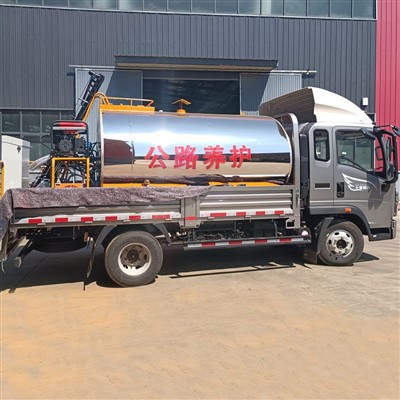
Emulsion asphalt is a crucial material widely used in road construction and maintenance. As a leading supplier of Emulsion Asphalt Plant, I am delighted to share how our plant produces high - quality emulsion asphalt.
Raw Materials Preparation
The production of emulsion asphalt starts with the careful selection and preparation of raw materials. The two main components are bitumen and water. Bitumen, a viscous and black material derived from petroleum, is the base ingredient that imparts the necessary binding properties to the emulsion asphalt. We source high - grade bitumen from reliable suppliers to ensure the consistency and quality of our final product.
Water is also a key ingredient and must be of high quality. Impurities in water, such as dirt, salts, and microorganisms, can negatively affect the stability and performance of the emulsion. Therefore, we use treated water that has undergone a series of purification processes, including filtration and disinfection.
In addition to bitumen and water, emulsifiers play a vital role. Emulsifiers are surface - active agents that reduce the surface tension between bitumen and water, allowing the bitumen to be dispersed evenly in the water phase. Different types of emulsifiers are available, such as anionic, cationic, and non - ionic emulsifiers. The choice of emulsifier depends on factors like the type of bitumen, the intended use of the emulsion asphalt, and the environmental conditions.
Pre - Mixing Phase
Once the raw materials are ready, we move on to the pre - mixing phase. The bitumen is first heated to a specific temperature, usually around 120 - 130°C, to reduce its viscosity. This makes it easier to handle and mix with other components. The heating process is carefully controlled to prevent over - heating, which can cause the bitumen to degrade and lose its desirable properties.
In a separate mixing tank, the emulsifier is added to the water. The amount of emulsifier added is determined by the type of bitumen and the required properties of the final emulsion. The water - emulsifier mixture is then vigorously stirred to ensure that the emulsifier is evenly dissolved in the water.
Homogenization
After the pre - mixing, the heated bitumen and the water - emulsifier solution are pumped into a colloid mill, which is the heart of our Asphalt Emulsion Equipment. The colloid mill consists of a rotor and a stator, which rotate at high speeds relative to each other. As the bitumen and the water - emulsifier mixture pass through the narrow gap between the rotor and the stator, the high shear forces generated break the bitumen into tiny droplets.
These droplets are then dispersed in the water phase, forming a stable emulsion. The size of the bitumen droplets is crucial for the quality of the emulsion asphalt. Smaller droplets result in a more stable emulsion with better adhesive properties. Our colloid mills are designed to precisely control the droplet size, ensuring that the emulsion meets the strict quality standards.
Quality Control
Quality control is an integral part of the production process. At various stages of production, we take samples of the emulsion asphalt for testing. One of the key tests is the stability test. This test measures the ability of the emulsion to remain in a stable state without separating into its components (bitumen and water) over a certain period. A stable emulsion is essential for proper handling, storage, and application.
We also test the viscosity of the emulsion. Viscosity affects how easily the emulsion can be pumped, sprayed, or mixed with other materials. By adjusting the production parameters, such as the ratio of bitumen to water and the emulsifier concentration, we can achieve the desired viscosity for different applications.
Another important test is the setting time test. The setting time of the emulsion asphalt determines how quickly it will harden after application. This is critical in road construction, where traffic needs to be restored as soon as possible. Our production process allows us to precisely control the setting time of the emulsion asphalt according to the specific requirements of the project.
Additives and Modifications
Depending on the specific application of the emulsion asphalt, we may add various additives or modifiers. For example, polymers can be added to improve the elasticity and durability of the emulsion. Polymers such as styrene - butadiene - styrene (SBS) can enhance the resistance of the emulsion asphalt to cracking, rutting, and aging.
Antioxidants can also be added to prevent the oxidation of the bitumen, which can cause the emulsion to become brittle over time. Anti - stripping agents are used to improve the adhesion between the bitumen and the aggregate in the road surface, especially in wet conditions.
Packaging and Storage
Once the emulsion asphalt has passed all the quality tests, it is ready for packaging. We offer various packaging options, including drums, tankers, and bulk storage. The packaging is designed to protect the emulsion from external factors such as sunlight, air, and moisture, which can affect its quality.
Proper storage is also crucial to maintain the quality of the emulsion asphalt. The storage temperature should be within a specific range, usually between 5 - 35°C. If the temperature is too low, the emulsion may freeze and lose its stability. If the temperature is too high, the emulsion may break down or polymerize prematurely.
Advantages of Our Emulsion Asphalt Plant
Our Emulsion Bitumen Equipment is designed with advanced technology and high - quality components. This ensures a high - efficiency production process, with a large production capacity that can meet the demands of various construction projects.
We also have a team of experienced engineers and technicians who are dedicated to optimizing the production process. They constantly monitor the production parameters, conduct quality control tests, and make adjustments as needed to ensure the consistent quality of our emulsion asphalt.
In addition, our plant is designed with environmental protection in mind. We use advanced waste management systems to minimize the environmental impact of the production process. For example, we recycle and reuse some of the by - products generated during the production, reducing waste and conserving resources.
Conclusion
In conclusion, the production of emulsion asphalt in our plant is a sophisticated process that involves multiple steps, from raw material preparation to packaging and storage. Each step is carefully controlled to ensure the quality and performance of the final product.
Whether you are working on a small - scale road repair project or a large - scale highway construction, our emulsion asphalt can meet your needs. Our commitment to quality, efficiency, and environmental protection makes us a reliable partner for your construction projects.


If you are interested in purchasing our emulsion asphalt or learning more about our Emulsion Asphalt Plant, please feel free to contact us for further discussions and quotations. We are looking forward to working with you to achieve your construction goals.
References
- Asphalt Institute. "Emulsion Asphalt Technology."
- Shell Bitumen Handbook. "Production and Use of Bituminous Materials."