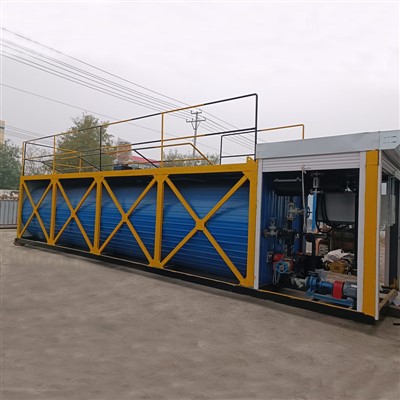
A bitumen emulsion plant is a crucial facility in the construction and road - building industries. As a well - established supplier of Bitumen Emulsion Plant, I have in - depth knowledge of the main components that make up such a plant. In this blog, I will break down these components and explain their functions.
Bitumen Storage Tanks
Bitumen storage tanks are the starting point of the bitumen emulsion production process. These tanks are designed to store bitumen at a specific temperature to maintain its fluidity. Bitumen is a highly viscous material, and it needs to be heated to a certain temperature (usually around 130 - 160 degrees Celsius) to be easily pumped and processed.
The size of the bitumen storage tanks can vary depending on the production capacity of the plant. Larger plants may have tanks with capacities of several thousand liters. These tanks are often equipped with heating systems, such as steam coils or electrical heating elements, to keep the bitumen at the optimal temperature. Additionally, they are fitted with level indicators to monitor the amount of bitumen in the tank, ensuring that there is a continuous supply for the production process.
Water Storage Tanks
Water is another essential component in bitumen emulsion production. Water storage tanks are used to store the water that will be mixed with the bitumen. The water used in the process should be clean and free from impurities to ensure the quality of the emulsion.
Similar to bitumen storage tanks, water storage tanks also have level indicators. In some cases, the water may need to be pre - treated, for example, by passing it through a filtration system to remove any suspended particles. The temperature of the water can also be adjusted to a suitable level, usually around 40 - 60 degrees Celsius, to facilitate the emulsification process.
Emulsifier Storage and Dosing System
Emulsifiers play a vital role in bitumen emulsion production. They are substances that help to disperse the bitumen droplets in the water phase, creating a stable emulsion. The emulsifier storage system is responsible for storing the emulsifier solution.
The dosing system precisely controls the amount of emulsifier added to the water - bitumen mixture. This is a critical step because the correct dosage of the emulsifier affects the stability, particle size, and other properties of the bitumen emulsion. Modern dosing systems are often automated, using pumps and flow meters to ensure accurate and consistent dosing.
Colloid Mill
The colloid mill is one of the most important components of a bitumen emulsion plant. It is the heart of the emulsification process. The colloid mill works by shearing the bitumen and water mixture at high speeds, breaking the bitumen into tiny droplets and dispersing them evenly in the water phase.
The working principle of a colloid mill involves a rotor - stator system. The rotor rotates at a very high speed, creating a high - shear force between the rotor and the stator. This shear force breaks the bitumen into droplets with a diameter typically in the range of 1 - 10 micrometers. The efficiency of the colloid mill depends on factors such as the rotational speed, the gap between the rotor and the stator, and the viscosity of the input materials.
Mixing Tanks
After passing through the colloid mill, the bitumen emulsion is transferred to mixing tanks. These tanks are used to further homogenize the emulsion and ensure that all the components are evenly distributed. The mixing tanks are equipped with agitators, which continuously stir the emulsion to prevent the bitumen droplets from coalescing.
The size of the mixing tanks can vary, and multiple mixing tanks may be used in a large - scale plant. The mixing time in these tanks is carefully controlled to achieve the desired properties of the emulsion, such as stability and viscosity.
Pumping Systems
Pumping systems are used throughout the bitumen emulsion plant to transfer the various materials, including bitumen, water, emulsifier solution, and the final emulsion. Different types of pumps are used depending on the properties of the fluid being pumped.
For example, positive displacement pumps are often used for pumping bitumen because of its high viscosity. Centrifugal pumps are commonly used for pumping water and the emulsifier solution. The pumping systems are designed to provide a continuous and stable flow of materials, ensuring the smooth operation of the entire production process.
Control Panel and Automation System
In modern bitumen emulsion plants, a control panel and automation system are essential components. The control panel allows operators to monitor and control various parameters of the production process, such as temperature, flow rate, and dosing quantity.
The automation system can be programmed to perform specific tasks, such as starting and stopping the pumps, adjusting the temperature of the storage tanks, and controlling the dosing of the emulsifier. This not only improves the efficiency of the production process but also reduces the risk of human error. With the help of sensors and feedback loops, the automation system can maintain the production process within the desired parameters, ensuring the consistent quality of the bitumen emulsion.
Quality Control Equipment
Quality control is of utmost importance in bitumen emulsion production. Quality control equipment is used to test the properties of the bitumen emulsion at various stages of the production process. This includes equipment for measuring the particle size distribution, viscosity, stability, and other important parameters.
For example, a particle size analyzer can be used to determine the size of the bitumen droplets in the emulsion. A viscometer is used to measure the viscosity of the emulsion, which affects its application properties. By regularly testing the emulsion, any deviations from the desired quality can be detected early, and corrective measures can be taken.
Storage and Packaging Unit for the Final Product
Once the bitumen emulsion is produced and passes the quality control tests, it is transferred to the storage and packaging unit. The storage tanks for the final product are designed to store the emulsion under suitable conditions to maintain its quality.
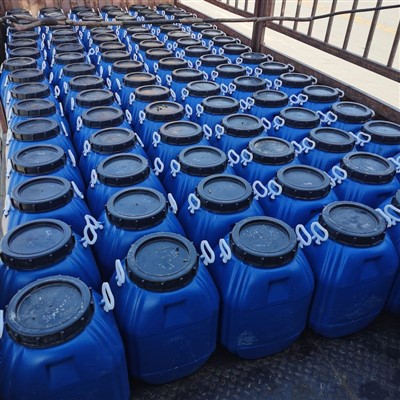
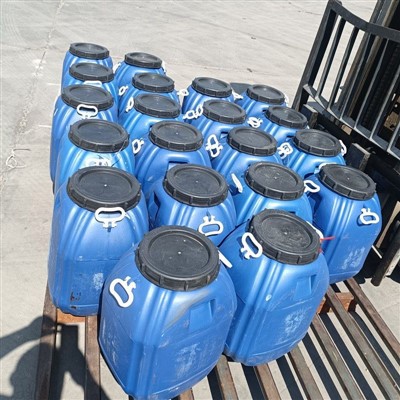
The packaging unit is responsible for filling the bitumen emulsion into containers, such as drums or bulk tankers, for transportation and distribution. The packaging process needs to be carefully controlled to prevent contamination and ensure the integrity of the product.
As a supplier of Bitumen Emulsion Equipment and Emulsion Asphalt Plant, we understand the importance of each component in a bitumen emulsion plant. Our plants are designed with high - quality components and advanced technology to ensure efficient and reliable production.
If you are in the market for a bitumen emulsion plant or have any questions about our products and services, we invite you to contact us for a detailed discussion. We are committed to providing you with the best solutions tailored to your specific needs.


References
- "Bitumen Emulsion Technology and Applications" by various authors.
- Industry standards and guidelines related to bitumen emulsion production.