

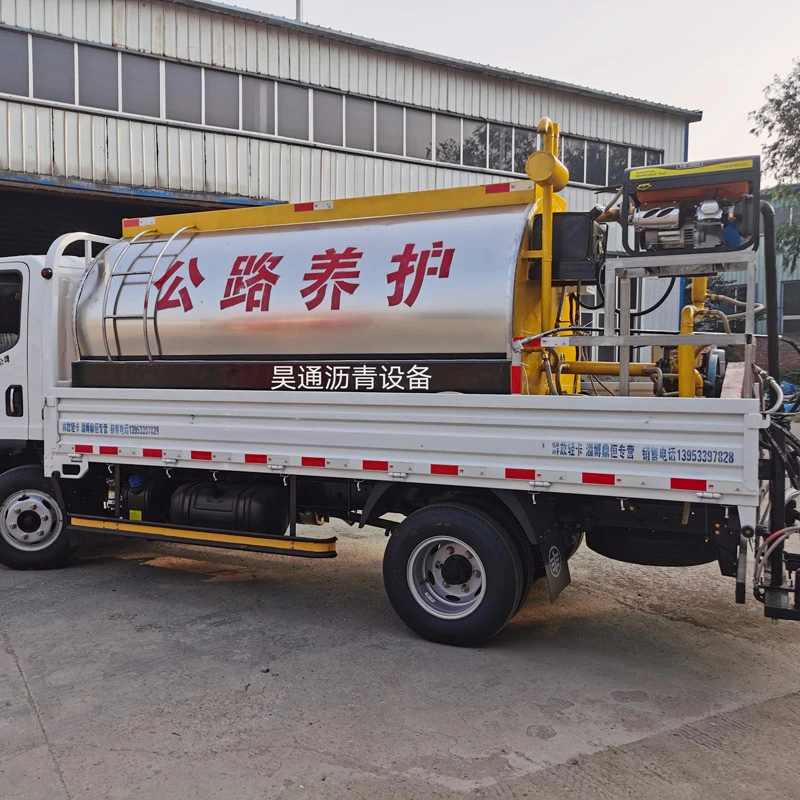
Whether asphalt is hot during asphalt‑distributor‑truck operation depends on the asphalt material type. Hot molten asphalt prevails in mainstream engineering construction, whereas ambient‑temperature asphalt is only used for a small number of simple‑maintenance scenarios. Distributor trucks are fitted with dedicated temperature‑control systems to stabilize asphalt working conditions.
Base asphalt, SBS‑modified asphalt, rubberized asphalt and other core materials for main‑body road construction are solid or semi‑solid at ambient temperature, with high hardness and poor fluidity, so they cannot be sprayed directly. They must be heated to turn liquid before construction. The operating temperature for conventional base asphalt should be maintained at 130 ℃‑160 ℃. For modified asphalt and rubberized asphalt with higher‑performance requirements, heating temperatures reach 160 ℃‑180 ℃. Only at qualified temperatures can asphalt become fully liquefied with appropriate viscosity. After atomization by distributor‑truck nozzles, it forms uniform thin asphalt films that adhere firmly to road bases or surface layers and deliver favorable bonding, penetration and waterproof performance.
To secure hot‑asphalt operation effects, asphalt distributor trucks are all equipped with dedicated heating, thermal‑insulation and temperature‑control systems. Tank bodies are fitted with heat‑conducting‑oil heating devices to independently heat and maintain constant temperatures for asphalt inside tanks and prevent asphalt cooling and solidification during transportation and operation. Meanwhile, pipelines and nozzles are equipped with heat‑tracing thermal‑insulation devices to avoid asphalt condensation and blockage inside pipelines and ensure smooth spraying and uniform atomization throughout operations. Insufficient asphalt temperature results in high viscosity, poor atomization, streaming flow, accumulation and missed spraying, which directly undermine construction quality. Therefore, temperature control for hot‑asphalt work represents a core construction link.
Emulsified asphalt is the sole exception for ambient‑temperature application. As liquid mixtures blended from asphalt, water and emulsifiers, emulsified asphalt exhibits good fluidity at ambient temperature and can be sprayed directly without heating. It is mainly deployed for low‑standard‑work scenarios such as simple rural‑road maintenance, pavement‑surface fog seals and temporary‑pavement bonding. Nevertheless, its bonding strength and stability are far inferior to hot asphalt. It cannot be adopted for structural‑layer construction of trunk highways and high‑standard pavements and merely serves as an auxiliary maintenance material.
Per engineering specifications, hot‑asphalt spraying is mandatory for core projects including newly‑built highways, municipal trunk roads, bridge‑deck waterproofing and structural‑layer bonding. Operating temperatures shall be strictly controlled to guarantee interlayer‑bonding strength and road service life. Ambient‑temperature emulsified asphalt is only used for sporadic, low‑standard simple‑maintenance work. Consequently, asphalt remains at high temperatures for conventional asphalt‑distributing operations across the industry, and ambient‑temperature asphalt is merely a niche supplementary option. Operating temperatures must be closely monitored: excessive temperature triggers asphalt aging and failure, while insufficient temperature impairs construction outcomes. Temperature‑control systems count among the core configurations of asphalt distributor trucks.


